Yesterday at 05:42 AM1 day 46 minutes ago, USAwx said:RRFSA was a hecsAt that time, there are (-10F) degree dew point temperatures from Hartford northward on that model.
Yesterday at 06:07 AM1 day Good thump to sleet then dry slots lol Primary is weak yet this still tucks the coast 3 hrs slower and 10mi east of previous run.
Yesterday at 06:14 AM1 day 54 minutes ago, jsantabanyc said:I’ll run with this and name this winter the best in the last few years lol@jsantabanyc For you and I, I do like what I am seeing overall other than the last few ridiculous Canadian runs which makes no sense. I guess anything is possible but I like where we are both at for a nice MECS type storm solution. Buckle up this will continue to be a wild and fun ride tracking these last 48-72 hours or so.
Yesterday at 06:31 AM1 day Tomorrow runs are critical. Will include full ROAB drop sonds from the typical sparse areas over the pacific AK and Canada. Might take a run or two to fully ingest.
Yesterday at 09:41 AM1 day Probabilistic Heavy Snow and Icing Discussion NWS Weather Prediction Center College Park MD 345 AM EST Thu Jan 22 2026 Valid 12Z Thu Jan 22 2026 - 12Z Sun Jan 25 2026 ***Significant Winter Storm To Bring Potentially Crippling Impacts To Parts Of The South Friday Through This Weekend, Expanding Up The East Coast Saturday Night Into Sunday*** ...Southern Rockies and Southern Plains through the Ohio/Tennessee Valleys into the Mid-Atlantic... Days 2-3... Estimated over 130 million residents under winter weather headlines this morning as confidence continues to increase on a highly impactful and extremely wide- reaching winter storm to begin on Friday across the south-central U.S., eventually pushing towards the East Coast by Saturday night into Sunday. Guidance has nearly unanimously converged on the upper low churning just west of southern CA (sampled by recon aircraft for the recent 00z model suite) to eject eastward ahead of a diving northern stream shortwave and fully phase by the day 4 timeframe. Uncertainty remains associated with the speed of the approaching northern stream trough, which eventually leads to the amplified pattern in the central/eastern U.S.. However, this uncertainty has decreased tonight as guidance converges on cluster 1 from WPC's 12z 1/21 clusters. Some guidance remains more amped (CMC/ECMWF) than others (GFS) and leads to some lingering uncertainty regarding the northern extent of heavy QPF and the mid- level warm nose. However, all scenarios now point to a large QPF footprint falling in the form of frozen precipitation and resulting in a significant winter storm. The aforementioned southern CA upper low will help surge ample Pacific moisture (above the 90th climatological percentile per the 12z NAEFS) into the southern U.S. by Friday night, where a deep arctic airmass is placed in ideal position for overrunning and wintry precipitation. This arctic airmass in place is brought to the region by a near record 1050mb surface high pressure over the Northern Plains on Friday. As time progresses this high pressure is expected to moderate and evolve into more of a "banana" look, which is classic for heavy winter precipitation in the East as low-levl cold air continues to sink southward towards a stationary front forecast to stretch along the Gulf Coast. A few weak areas of low pressure are forecast to form along this front before gradually lifting northward into the TN Valley and along the Carolina coastline by the end of D3. Decided to split up the remainder of the discussion into hazard- type categories given this event covers such a massive amount of real- estate. For local forecasts and more details, read your local WFOs AFD. Heavy Freezing Rain/Sleet... Arguably the most lasting impact associated with this winter storm could be from heavy accumulating freezing rain and sleet stretching from the southern Plains, Mid-South, Tennessee Valley, and southern Mid- Atlantic. This is due to very cold low-level arctic air being reinforced by the strong high over the north- central U.S. and a warm nose aloft (at around 750mb per cross section model soundings) melting snow as it falls through the column before refreezing just before or at the surface. The greatest freezing rain amounts and impacts are currently forecast across northeast TX through northern MS as favorable thermal profiles linger for over 24 hours beginning Friday night. WPC 72-hour probabilities for >0.5" of freezing rain are high >70% across southern AR into parts of northwest MS. Here, ice accretion could be crippling and exceed 0.75-1.00", which would very likely lead to widespread long- lasting damage to infrastructure, including power outages and tree damage. Major sleet accumulations are also likely just north of the freezing rain area stretching from southern OK/north TX through central AR and into the Mid- South, with more than a few inches of sleet possible. This could make for treacherous driving conditions and lasting travel impacts due to the bitterly cold airmass expected to linger into next week over the region. Heavy icing is also likely into the TN Valley and nearby southern Appalachians and Mid- Atlantic, where freezing rain continues beyond the D3 timeframe. The setup across the southern Mid-Atlantic down as far south as northern GA and areas just inland from the coasts of the Carolinas is an extreme case of CAD with a 1040mb high situated over the Interior Northeast on Saturday night. This high pressure filters very low/dry dew points with values below zero prior to precip onset late Saturday. This cold air wedge remains sharply locked in place at the surface for the remainder of the event as 700-850mb temperatures begin to increase well above freezing by the end of D3 throughout the Carolinas and northern GA. WPC probabilities for >0.25" of freezing rain accretion through 12z Sun. are currently 40-70% from northern AL/TN through northern GA and into the Midlands of SC and areas just inland of the NC Tidewater region. Heavy sleet accumulations are also possible where the low-level column remains colder into VA Piedmont. Heavy Snow... North of the mixed precipitation area and closely tide to both a favorable LFQ of a zonally oriented 180kt upper jet and strong 700mb fgen, snow is the primary precipitation type stretching from the southern High Plains of east-central NM and the southern Rockies through the Plains, Mid-Mississippi Valley, Ohio Valley, and Mid-Atlantic by Sunday morning. Favorable upslope flow as the strong arctic high pressure noses southward along the High Plains starts on Friday across the southern Rockies, with light snow and even a chance for freezing drizzle at onset across the central Plains until the column fully saturates. Heavy snow is then forecast to begin breaking out Friday night from the central/southern Plains through the mid-Mississippi Valley and spanning much of the Ohio Valley and parts of the Midwest on Saturday. Snowfall rates could near 1"/hr as strong lift intersects with a region about 150 miles north of the mixed precip zone where the DGZ is forecast to be extremely deep (about 500 mb per areal average soundings). This would allow for efficient formation of dendrites where ample lift can fully moisture the column. Should a region remain in this zone for a longer enough period it's not out of the realm of possibility 30:1 snow ratios are observed. However, most locations appears to progressively see this favorable DGZ move east-northeast with time and shrink as mid-level temperatures increase above -8C and allows for more needles than dendrites. WPC probabilities for >6" of snow through 12z Sun. are medium to high (30-70%) stretching from east-central NM and the TX Panhandle across northern OK, into the Mid-Mississippi Valley. These probabilities increase to above 70% in the Ohio Valley, where 8-10" of snow is possible. The widespread nature of this heavy snow is likely to significantly impact both ground and air travel in the region. One area that is slowly becoming the most favorable location for heavy snowfall rates and potentially the most impressive snowfall amounts is the central Appalachians, northern VA, MD, and southern PA through early Sunday. As the upper level trough deepens over the central U.S. Saturday night, mid- level flow begins to increase out ahead of it and meets the mid-level warm front stretching from the eastern Ohio Valley into the Mid- Atlantic. Several 00z models highlight increasing 700mb fgen over the eastern Ohio Valley and into central VA by late D3, which supports the potential for an extended period of 1"/hr rates across much of eastern WV, central/northern VA, MD, and southern PA. The 0C warm nose may begin to approach northern VA by the end of D3, but areas just to the north could see 6-12" by sunrise on Sunday as precipitation lingering further into the day on Sunday. Snow ratios will also be favorable at onset and could potentially exceed 20:1 within enhanced banding, which is well above the 11:1 climatology in the region. Current WPC probabilities through D3 are medium to high (40-70%) for at least 8" of snow, this includes areas just west of I-95 from D.C. to Baltimore. Heavy snow is expected to continue stretching into the Northeast and New England on Sunday, see WPC's Extended Forecast Discussion for more. Also, see the Key Messages linked at the bottom of this discussion. ...Great Lakes... Days 1-2... A Hudson Bay vortex pivoting south through Ontario will sustain the seemingly endless cyclonic flow over the Great Lakes and their usual snow belts before strong high pressure builds overhead on D3 and ends this lake effect pattern for the time being. 500mb heights associated with this powerful upper low are quite anomalous (below the 1st climatological percentile per 12z NAEFS in southern Ontario Thursday into Friday night). WPC probabilities highlight medium-high chances (>60%) for snowfall totals >6" over the northern tier of the U.P., along the Chautauqua Ridge on north into western NY, and down wind of Lake Ontario over the Tug Hill. The Tug Hill most notably will continue to receive very heavy snow over the next few days highlighted by WPC 48-hour probabilities sporting high chances (>70%) for >8" in the Tug Hill. A growing concern is for snow squalls over the Northeast. WPC initiated Key Messages for what appear to be multiple rounds of snow squalls from western NY on east through New England, with some squalls possible as far south as northern PA early today. This is highlighted well in CAMs snow squall parameter, with highest potential on Thursday from western PA through central NY. The final round of squalls are expected on Friday as an arctic front traverses the region, causing steep lapse rates and focused vertical ascent. This front will also usher dangerously cold temperatures and wind chills. For more details on the snow squall threat in the Northeast through Friday, please refer to our Key Messages. Snell ...Winter Storm/Snow Squall/Extreme Cold Key Messages are in effect. Please see current Key Messages below... https://www.wpc.ncep.noaa.gov/key_messages/LatestKeyMessage_1.png https://www.wpc.ncep.noaa.gov/key_messages/LatestKeyMessage_2.png https://www.wpc.ncep.noaa.gov/key_messages/LatestKeyMessage_3.png
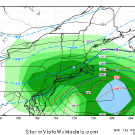
Yesterday at 10:07 AM1 day 3 minutes ago, USAwx said:6z GFS is an absolute monsterIt would be a regional all-timer.
Yesterday at 10:15 AM1 day Author Hard to trust the gfs so weighting it 20%would give ukie/euro 80 percent blendnot using icon/ggem.rgem as they do not match the synoptic pattern and seem to be erroneously warming mid levelseven the NAM isn't showing that crazy kind of warmth





Create an account or sign in to comment